- Home
- Awareness
What we do
Awareness
Know the symptoms — and help us make sure everybody else does too.

Symptoms
What are the symptoms?
Ovarian cancer is often found late, because its early signs are easy to put down to something else. These are the ones to know.
- Abnormal vaginal bleeding or discharge
- Pelvic or abdominal pain
- Back pain
- Bloating
- Feeling full quickly while eating
- A change in bathroom habits — needing to urinate more often, constipation or diarrhea
If a symptom lasts two weeks or more, seek the attention of a medical professional. Early detection makes treatment more effective.
Reducing risk
What can I do to reduce my risk?
There is no sure way to prevent ovarian cancer. These things may help reduce the chance of getting it — but they are not recommended as prevention methods on their own, because each carries its own risks and benefits. The right choice is a conversation with your doctor.
Birth control pills
Use of oral contraceptives is associated with a lower risk.
Tubal ligation, ovary removal or hysterectomy
Gynecologic surgeries of this kind are associated with a lower risk. They are decisions made for other reasons, with a doctor.
Having given birth
Women who have given birth have a somewhat lower risk.
Breastfeeding for a year or longer
Extended breastfeeding is associated with a lower risk.
At a glance
What you should know about ovarian cancer
Symptom and risk information on this page is from the Division of Cancer Prevention and Control, Centers for Disease Control and Prevention. Talk to your doctor about anything on it. CDC: ovarian cancer →
Test yourself
How much do you know about ovarian cancer?
Nine questions, with the answer explained either way. It takes about three minutes, and nobody sees how you did.
-
Question 1 of 9
Which of these are considered common symptoms of ovarian cancer?
Correct
Several studies show that ovarian cancer can produce all of these: bloating, difficulty eating and feeling full quickly, abdominal or pelvic pain, and urinary issues such as urgency or frequency.
Symptoms often do not appear until the disease has advanced, and they can be subtle and easily mistaken for other, more common problems.
If these symptoms last more than two weeks, and are new and unusual for you, see your gynecologist and ask about ovarian cancer.
Not quite
Good guess, but ovarian cancer can produce all of these: bloating, difficulty eating and feeling full quickly, abdominal or pelvic pain, and urinary issues such as urgency or frequency.
Symptoms often do not appear until the disease has advanced, and they can be subtle and easily mistaken for other, more common problems.
If these symptoms last more than two weeks, and are new and unusual for you, see your gynecologist and ask about ovarian cancer.
-
Question 2 of 9
True or false: screening for ovarian cancer is simple, and can be done quickly and effectively at your annual gynecologic exam.
Correct
You are right. There is no early detection test or screening tool for ovarian cancer.
A Pap smear, which is performed at annual gynecologic checkups, only screens for cervical cancer.
That is why it matters so much to know the risk factors, including your own, and the common symptoms of the disease.
Not quite
That is a common misconception. There is no early detection test or screening tool for ovarian cancer.
A Pap smear, which is performed at annual gynecologic checkups, only screens for cervical cancer.
That is why it matters so much to know the risk factors, including your own, and the common symptoms of the disease.
-
Question 3 of 9
Every 23 minutes another woman is diagnosed with ovarian cancer. How many cases are found early, when it is most treatable?
Correct
Unfortunately, you are right. Ovarian cancer is stealthy: the symptoms are late to appear and easy to miss, and there is no early detection test. Just 15 percent of patients are diagnosed in the cancer’s earliest stages.
Not quite
Not quite. Ovarian cancer is stealthy: the symptoms are late to appear and easy to miss, and there is no early detection test. Just 15 percent of patients are diagnosed in the cancer’s earliest stages.
-
Question 4 of 9
Some things can actually reduce a person’s chance of developing ovarian cancer. Which of these lower the risk?
Correct
Yes. Starting menstruation after age 12, taking oral contraceptives, giving birth and breastfeeding all decrease the risk of ovarian cancer.
Ovulation is thought to contribute to ovarian cancer in some cases, so the more menstrual cycles a person goes through, the more opportunities there are for damage in the process of releasing an egg. Each of these reduces the number of times a person ovulates in their life.
Not quite
Close. Starting menstruation after age 12, taking oral contraceptives, giving birth and breastfeeding all decrease the risk of ovarian cancer.
Ovulation is thought to contribute to ovarian cancer in some cases, so the more menstrual cycles a person goes through, the more opportunities there are for damage in the process of releasing an egg. Each of these reduces the number of times a person ovulates in their life.
-
Question 5 of 9
And which of these are known to increase the risk of ovarian cancer?
Correct
For the general population, every one of these has been linked to an increased risk: advanced age, menopause and being post-menopausal, hormone replacement therapy, and obesity.
A note on age. Ovarian cancer rates are highest in women aged 55 to 64, which is true, but the risk begins rising at 40.
Not quite
In fact every one of these has been linked to an increased risk for the general population: advanced age, menopause and being post-menopausal, hormone replacement therapy, and obesity.
A note on age. Ovarian cancer rates are highest in women aged 55 to 64, which is true, but the risk begins rising at 40.
-
Question 6 of 9
Which medical conditions can also increase a person’s risk of developing ovarian cancer?
Correct
Yes. A personal history of endometriosis, or of breast, uterine or colon cancer, can all mean an increased risk of ovarian cancer.
Family history matters too. If a close blood relative has been diagnosed with ovarian cancer at any age, or with breast, uterine or colon cancer before 50, you are also at increased risk.
Not quite
Actually all of them. A personal history of endometriosis, or of breast, uterine or colon cancer, can increase the likelihood of developing ovarian cancer.
Family history matters too. If a close blood relative has been diagnosed with ovarian cancer at any age, or with breast, uterine or colon cancer before 50, you are also at increased risk.
-
Question 7 of 9
True or false: genetics and heredity play a part in who is more likely to develop ovarian cancer.
Correct
You got it. About 20 to 25 percent of people diagnosed with ovarian cancer have a hereditary tendency to develop the disease.
The most significant risk factor is an inherited mutation in one of two genes, BRCA1 and BRCA2, which are responsible for about 10 to 15 percent of all ovarian cancers. Another known genetic link is an inherited syndrome called Lynch Syndrome.
Not quite
In fact about 20 to 25 percent of people diagnosed with ovarian cancer have a hereditary tendency to develop the disease.
The most significant risk factor is an inherited mutation in one of two genes, BRCA1 and BRCA2, which are responsible for about 10 to 15 percent of all ovarian cancers. Another known genetic link is an inherited syndrome called Lynch Syndrome.
-
Question 8 of 9
If you think you may be at increased risk of ovarian cancer, what should you do?
Correct
You got the trick question right. It is important to watch for symptoms, but if you think you may be at increased risk you should not simply wait for them to appear. The most important thing is to talk to your doctor now.
Your doctor may recommend genetic testing to work out your own risk level. If you know you are high-risk, there are preventative options that greatly reduce the chance of getting ovarian cancer.
Not quite
It was a bit of a trick question. It is important to watch for symptoms, but if you think you may be at increased risk, do not wait for them to appear. The most important thing is to talk to your doctor now.
Your doctor may recommend genetic testing to work out your own risk level. If you know you are high-risk, there are preventative options that greatly reduce the chance of getting ovarian cancer.
-
Question 9 of 9
If your doctor strongly suspects ovarian cancer and is recommending surgery, who is it important to consult before the operation?
Correct
Yes. The importance of consulting a gynecologic oncologist before initial surgery cannot be overstated.
Patients whose surgery is performed by a gynecologic oncologist, rather than a gynecologist or another non-specialized physician, have been shown to have better outcomes.
Not quite
The most important person to consult before surgery is a gynecologic oncologist, and the importance of that cannot be overstated.
Patients whose surgery is performed by a gynecologic oncologist, rather than a gynecologist or another non-specialized physician, have been shown to have better outcomes.
-
Now you know the symptoms
The next part matters more than the quiz. Tell somebody else, and talk to your doctor if anything here sounded familiar.
Take the pledge
Questions and explanations adapted from the Ovarian Cancer Research Alliance. This is awareness, not diagnosis: if something here sounds familiar, speak to a medical professional about your own risk.
Take the pledge
Know the symptoms. Tell somebody.
Ovarian cancer is found late because its early signs look like everyday things. The pledge is three sentences, and it is the whole point of this page.
I pledge to
- learn the symptoms of ovarian cancer.
- tell other women the symptoms of ovarian cancer.
- talk to my doctor if I suspect I may be at increased risk.
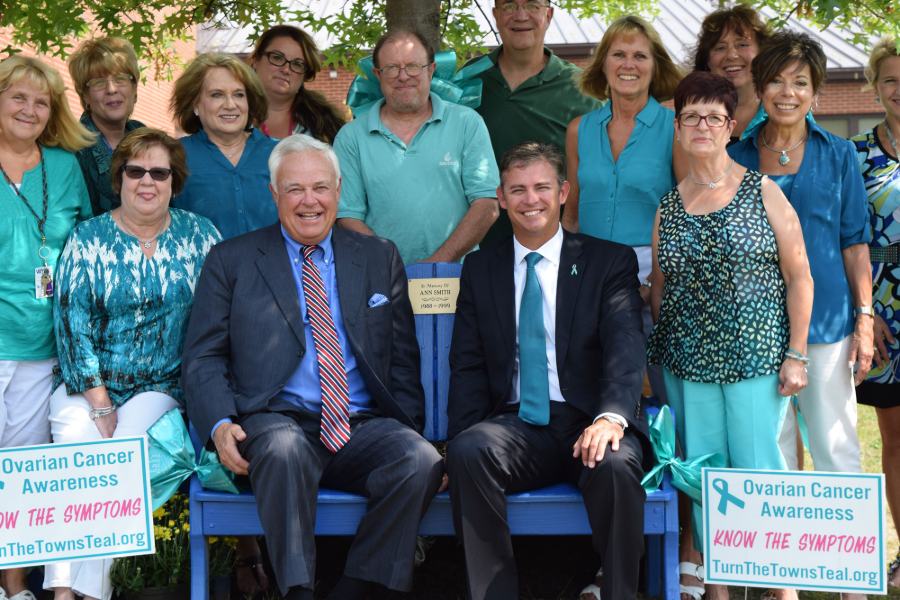
Screen One, Screen All
Questions about your symptoms? We can connect you to a provider.
The foundation partners with Chan Soon-Shiong Medical Center at Windber on Screen One, Screen All — a campaign reminding women that cervical, ovarian and breast health are equally important to catching cancer early.
In the words of Ann’s son, Matt Smith: "If women access our driveteal.com web site and have questions about their symptoms, we wanted to be able to connect them to a provider for an examination and treatment if needed."
Press release · April 28, 2021
Ann Harris Smith Foundation and Chan Soon-Shiong Medical Center at Windber collaborate to encourage women to Screen One, Screen All
Windber, Pa. — Two area non-profit organizations, the Ann Harris Smith Foundation and Chan Soon-Shiong Medical Center at Windber (CSSMCW), have partnered to promote Screen One Screen All, an awareness campaign encouraging women to schedule the health exams they may have put off.
CSSMCW launched the campaign in January after seeing how many screenings had been delayed during the pandemic. It centres on two of the medical center’s departments: the Joyce Murtha Breast Care Center and Windber GYN Associates.
"We created a three-color ribbon to serve as a reminder that cervical, ovarian, and breast health should be viewed as equally important" in detecting cancer early, said Erin Goins, Director of Women’s Health Services.
The Ann Harris Smith Foundation, established in 2000 following Ann Harris Smith’s Stage IV ovarian cancer diagnosis, joined the campaign to extend its ovarian cancer awareness work. "If women access our driveteal.com web site and have questions about their symptoms, we wanted to be able to connect them to a provider for an examination and treatment if needed," said Matt Smith, Ann’s son.
"This is a win-win for both the Ann Harris Smith Foundation and the medical center’s two female-focused departments," said Tom Kurtz, President and CEO of CSSMCW — connecting women with information, and with experienced providers.
Every September
Turn the Towns Teal®
In September, with the help of A LOT of volunteers, the Ann Harris Smith Foundation is proud to be part of Turn the Towns Teal® — a national campaign that ties teal ribbons through towns so that people stop, ask, and learn the symptoms.
Ours runs through cities across Cambria and Somerset Counties with the students of Bishop McCort Catholic High School. If you would like ribbons for your town, your business or your tree, ask.
Since May 2016
Teal Tuesdays
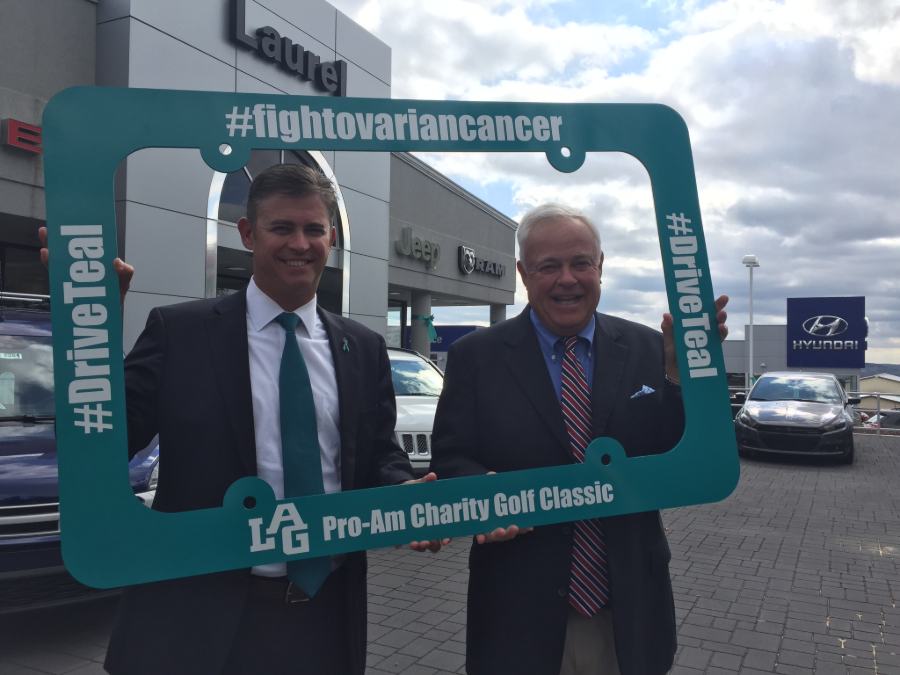
Every Tuesday, the employees of Laurel Auto Group wear teal to help raise awareness through customer interaction and public visibility.
We began this initiative in May of 2016 to honor Ann and all of the Smith family, and to join in their efforts to help women and families throughout our community. #DriveTeal #fightovariancancer

2016
The Laurel Toyota Teal-Mobile
In 2016, Laurel Toyota and the Ann Harris Smith Foundation took ovarian cancer awareness on the road — literally.
Laurel Toyota wrapped a Toyota Corolla with teal ribbons and added both the foundation logo and the Pro-Am Charity Golf logo. The hood has been collecting signatures ever since.

Laurel Mountain Hockey League
The Ann Harris Smith Cup
Johnstown-based Laurel Auto Group and the Ann Harris Smith Foundation donated three trophies to the Laurel Mountain Hockey League in memory of Ann, and are the league’s presenting sponsor.
The league crowns its champion and presents the cup each March at the Cambria County War Memorial Arena in Johnstown. Pictured: the Altoona Mountain Lions, 2016–17 varsity champions.
Your story matters
Tell your story
Survivors, families, friends. A story shared is awareness raised — for the woman who reads it and recognises her own symptoms, and for the family that feels less alone.